


Curved surface
Select the layer you want to apply a filter to, then select the [Filter] menu > [Distort] > [Curved surface] to open the dialog box. This distorts the images by making it appear as if it is reflected on a cylindrical or spherical surface.
|
Applicable layers |
Raster layer (color) Raster layer (gray) Raster layer (monochrome) |
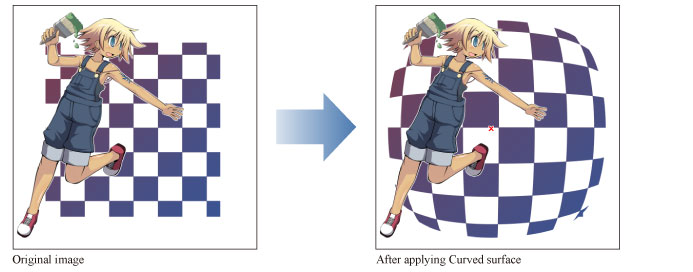
|
|
·To learn how to apply a [Distort] effect to a layer, see "Using the Distort Filters". ·If you create a selection area, the effect will only be applied to the selection area. You cannot change the size of the effect after applying the filter. ·For information on the settings in the [Curved surface] dialog box, please see the following section. |
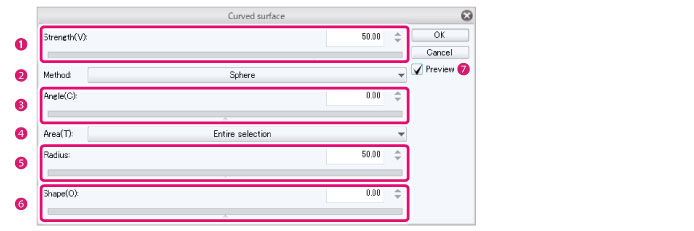
[Curved surface] dialog box
|
|
A red cross (X) will appear on the canvas while the dialog box is open. Drag this to set the center of the transformation. |
(1) Strength
Set the degree to which to transform the image.
·Set a positive number to curve the image toward the viewer.
·Set a negative number to curve the image away from the viewer.
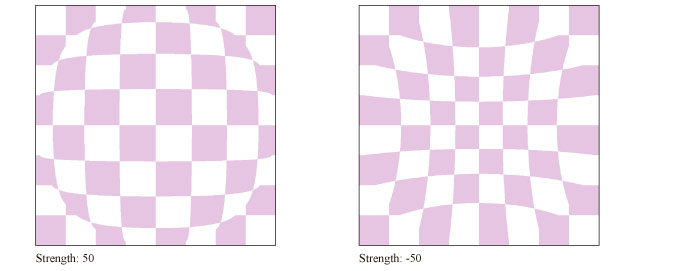
(2) Method
Allows you to set the type of curved face to apply to the image. You can select from [Cylinder] or [Sphere].
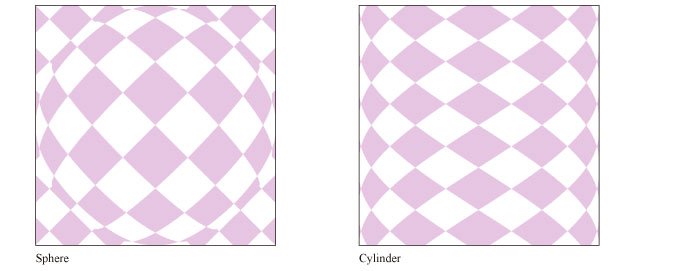
(3) Angle
Allows you to set the angle when set to [Cylinder].
(4) Area
Specify the range in which to apply the transformation effect.
|
Entire selection |
Applies the transformation effect to the entire image. |
|
Specify size (use radius/shape) |
Specifies the range and vertical/horizontal ratio of the transformation effect. Specify the range and vertical/horizontal ratio using the [Radius] and [Shape] settings. |
(5) Radius
Set the range of the image distortion.
(6) Shape
Set the vertical/horizontal ratio of the area to distort the image.
·Set a positive number to make the transformation range narrower horizontally.
·Set a negative number to make the transformation range narrower vertically.
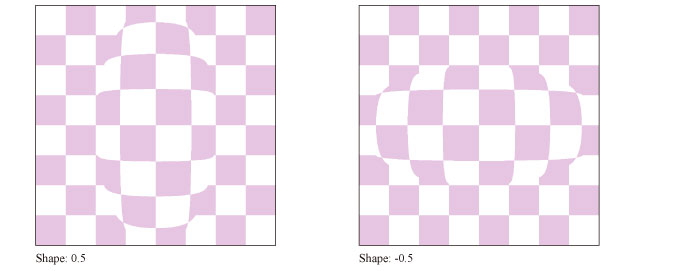
(7) Preview
Turn this on to preview the results on the canvas.